


April 8, 2012
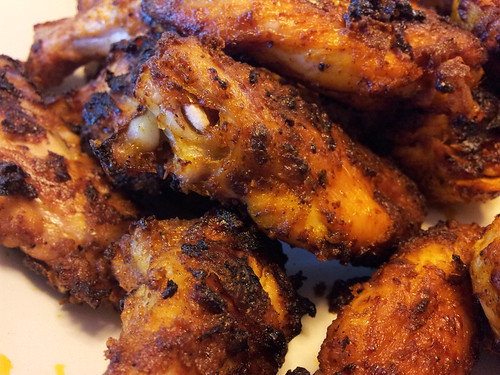
Tandoori Chicken Wings
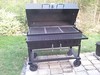
So, it has been a while. And what have I been doing with this while? Well, last fall, after many moons of faithful service, my old grill died. I decided to get serious about the new one. Specifically, I had one made by Klose. I dub it "The Beast":
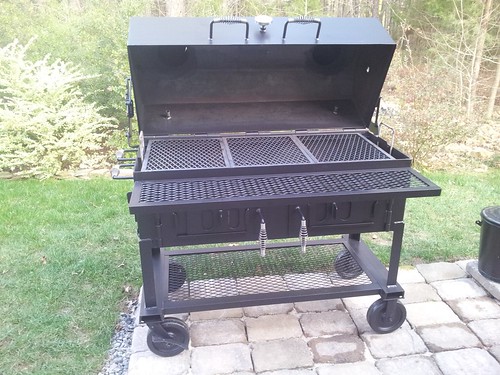
Anyway, it took me a while to get the back ready to receive The Beast, but I have now been happily grilling for around a month (well, less than cooperative weather permitting). I am still at the stage of getting the feel for the beast, but yesterday I landed a dish which is the subject of this post.
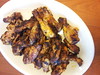
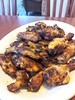
The dish for today is Tandoori chicken wings. Yesterday's try was the second iteration, and my description of the dish will include lessons learned from the first effort.
To begin with, you have to make Tandoori sauce. To do this, rough chop a medium onion, two inches of ginger, and 4 garlic cloves. Toss in a food processor with:
-the zest of 1 lemon;
-1 cup of plain (no need for Greek) yogurt;
-1/2 cup of vegetable oil (and don't be afraid to splash a little);
-1 Tablespoon of ground coriander;
-1 teaspoon of ground cumin;
-1 teaspoon of turmeric;
-1 teaspoon of gram masala;
-1/2 teaspoon nutmeg;
-1/2 teaspoon cinnamon;
-1/4 teaspoon of fresh, and finely, cracked black pepper.
Blend all of these ingredients together in a food processor to make the smoothest Tandoori sauce possible (maybe 3-5 minutes in low pulse). Two notes about this:
Continue reading "Tandoori Chicken Wings"
Posted by dag at 7:01 AM | Comments (1)
November 13, 2011
Pumpkin Polenta
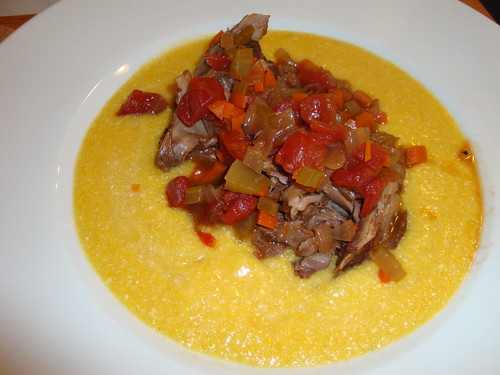
Braised lamb shank ladeled over some pumkin polenta.
One thing I love about fall (OK, one of the hundreds of things I love about fall) is the brief season of sugar pumpkins. I love fresh, farm to fork sugar pumpkins from my CSA or local farmer's markets. I really don't care for canned pumpkin, which in any case is often actually blue hubbard squash, and not real pumpkin.
So at this time of year I get to do a lot of neat things with some wonderful tasting pumpkin.* One of my favorites is a simple pumpkin polenta.
Here is how it works:
Take a sugar pumpkin, remove the stem and bore a hole from the stem area to the core, then puncture the upper half of the pumpkin with a pairing knife in 6-7 places, making sure the puncture reaches the core. It is extremely important that you bore this hole and make the cuts, and do so correctly: if you do not the pumpkin could explode on you!
Make a little aluminum foil base for the pumpkin and place in a 375° F (190.6° C) oven. Roast for about 1.5 hours, until an instant read thermometer inserted well into the flesh near the base of the pumpkin reads 180° F (82.2° C)
Remove the pumpkin and let cool to the point where you can handle it. Then slice the pumpkin in half and remove the seeds and pulp at the center.
Scoop out the flesh and run through a food mill. Add a dash of cinnamon and let fully cool and then mix in ricotta (about 1/4-1/3. depending on taste, of your volume of pumpkin).
Then, basically, make polenta for around 5-6 people and, when you are done with the polenta, mix in a dab of butter and then the pumpkin-ricotta mix. Mix through thoroughly. It makes a great base for things like rich fall braises.
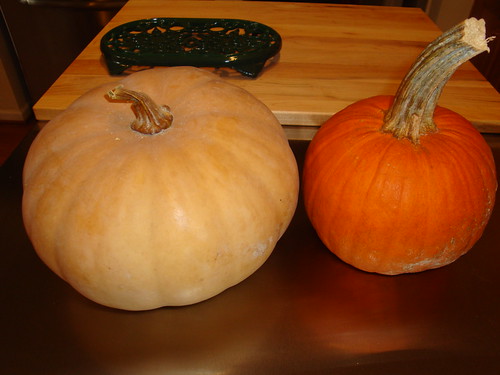
On the left is a Long Island Cheese Pumpkin, on the right is a basic sugar/pie pumpkin.
* I have been told that the Long Island Cheese Pumpkin is a very good substitute for the basic sugar/pie pumpkin. I will be experimenting with them as the winter roles on because a major advantage of the Long Island Cheese is that it is available here in the Southern Part of Heaven much deeper into the cold months than the pie pumpkin.
Posted by dag at 8:43 PM | Comments (0)
Obama's Soup
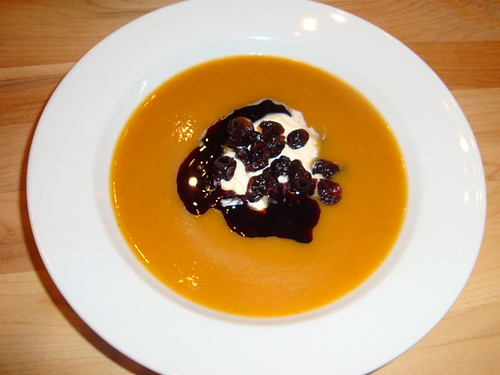
This is a recipe that I developed from the starting point of one provided in the New York Times by Sam Kass, President Obama's personal chef in the White House. I found the original to be somewhat half-hearted (i.e. mute flavors) but also maybe a touch too acidic. I re-worked it slightly to turn it into a fall classic in our household. It has a kind of creamy, squashy nuttiness braced by cider that, to me, is somehow just evocative of autumn. It is autumnal, you could say.
Anyway, the basic ingredients:
-Butternut Squash (I usually do 3-4 big ones or 4-5 medium ones);
-4-5 Apples. Kass used Granny Smiths, which I felt created too acidic a final product. I tend to use sweeter red apples, like Fuji's, Macs, Winesaps, etc.;
-Apple Cider (30-40 ounces, depending on your taste for acidity). Use real, pressed fall apple cider, not dressed up apple juice;
-14 ounces of chicken stock (I use Swanson's canned; I don't care for the taste of many of the fancier, pricier ones I've tried; I'll make my stock again someday, when I no longer have a 2 year old child);
-Salt, pepper, cinnamon;
-Nutmeg (buy 'em whole and grate them in with a Microplane-type grater);
-Dried cherries (if you have a choice, tarter cherries are better than sweet ones for this dish);
-Pumpkinseed oil (I use Styrian pumpkinseed oil from Austria; my favorite to date is from Castelmuro, but I plan to try La Tourangelle's take at some point);
-Crème fraîche (a tub that will be used for whopping dollops down on the soup just before serving).
-Any neutral oil (like grapeseed).
And now for the show:
Continue reading "Obama's Soup"
Posted by dag at 8:12 AM | Comments (0)
November 8, 2011
Duck and Squash Risotto
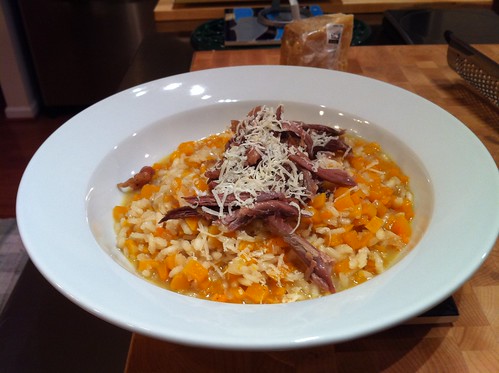
This is an adaptation of a recipe from Chef Charlie Palmer's Great American Food (a classic New American Cuisine cookbook). It basically marries the sweetness of a sweet Riesling with the sweetness of a fall squash (butternut is my favorite but he uses pumpkin) with the richness of duck confit and a creamy risotto. Its a great dish for a crisp fall weeknight evening: quick and hearty.
To serve around 2:
Continue reading "Duck and Squash Risotto"
Posted by dag at 7:03 PM | Comments (0)
November 6, 2011
Duck Breast 101
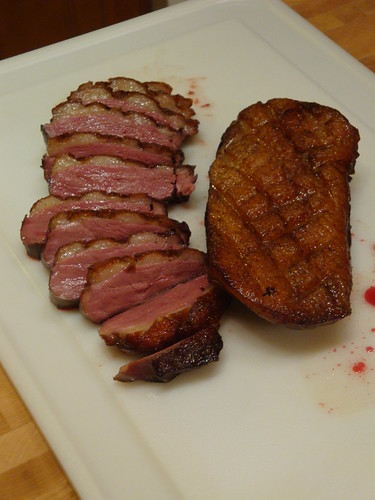
The topic du jour is duck breast. Duck breast is a staple of our household from the fall to late spring. There is something about the suite of duck, turnips, roast pumpkin, butternut squash soups, apples, bacon, cinnamon, curry, ... that just signals "fall" to me.
Let me begin with the basic steps:
1. Let the duck breast sit in the fridge (outside of any packaging) for days;
2. Sous vide the duck breast at 130°F (54°C) to 134°F (56.7°C) for hours (at least three);
3. Remove the duck from the water bath and vacuum seal;
4. Score the fat;
5. Place it fat side down in a frying pan (non-stick not necessary) and sautee until brown;
6. Flip over to given the non-fat parts heat for 3-4 seconds;
7. Remove from the frying pan and let rest fat side up for 10 minutes;
8. Heat up the duck fat in the frying pan and spoon some over the fat side of the duck breast;
9. Salt and pepper the fat side of the breast;
10. Let sit 1 minute on a cutting board;
11. Slice;
12. Transfer to a cooling rack over a flat pan for 2 minutes; hold reserve duck on rack;
12, part deux. A little holy smoke, perhaps?;
13. Plate with the remaining components and reserve the rest.
Continue reading "Duck Breast 101"
Posted by dag at 9:29 PM | Comments (0)